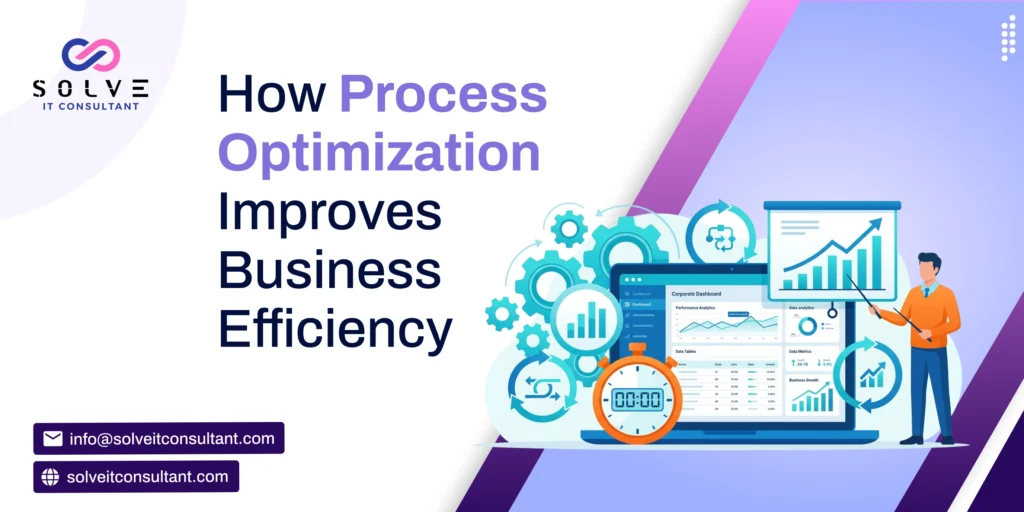
The current business world operates with fast-paced conditions that force businesses to adopt smarter work methods for maintaining their competitive edge and financial success. Businesses that depend on their outdated systems, together with their gradual operational processes, experience operational hindrances, which result in increased expenses and decreased customer satisfaction. Process optimization helps organizations improve their operations by identifying problems and implementing better solutions. The system enables businesses to achieve time savings and waste reductions together with productivity enhancements while maintaining their ability to deliver high-quality outputs.
What is Process Optimization?
“Process optimization” refers to the process of enhancing business operations through the development of faster, simpler, and more effective workflows. The process starts with a review of current operations to identify components that create work delays and require employees to redo their tasks. Through the use of technology, automation, and strategic planning, businesses achieve higher operational efficiency while minimizing their operational mistakes. The objective of the process is to produce superior outcomes that require less time and resources.
Reduces Operational Costs
Process optimization stands out as a key advantage because it enables organizations to decrease their operational costs. Companies waste financial resources through their inefficient systems, which lead to double work and manual mistakes that generate additional expenses. Workflow optimization enables businesses to eliminate nonproductive tasks while their employees work through essential business functions. This method enables organizations to enhance their financial results without decreasing the standards of their products and services.
Automation tools also play an important role in lowering operational costs. The system allows businesses to automate their basic tasks, which include data entry, together with invoicing and inventory management processes, to achieve labor and time savings. Businesses can decrease human mistakes while boosting precision through the implementation of advanced software solutions. Companies can now distribute their financial resources in a more effective way, which enables them to maintain their primary focus on their core business.
Improves Employee Productivity
Employee productivity increases when work processes maintain clear organizational systems which employees can easily understand. The combination of complicated workflows with repetitive work tasks causes employees to lose motivation, which results in wasted time during their actual work hours. Daily operations become easier to manage through process optimization, which lets employees dedicate their time to important strategic work. The result of this process creates a more pleasant workplace environment, which leads to higher employee contentment at their job.
Digital tools together with project management systems enable businesses to achieve better employee productivity results. Teams complete their assignments more quickly while making fewer errors because clear communication together with streamlined procedures enhances their work efficiency. Employees achieve higher work efficiency because they need to spend less time dealing with business operational challenges. The organization achieves its goals more quickly because increased productivity leads to better business results.
Improves Customer Happiness
Business success depends on customer happiness, which establishes a trustworthy relationship between customers and the business. Customer experience gets disrupted through service delays together with unprofessional communication and operational errors, which damage the brand’s reputation. Businesses can enhance their service delivery through process optimization, which enables them to provide quicker customer responses while maintaining service quality. The effective systems guarantee that customers obtain their products and services in a timely manner without experiencing any difficulties.
The implementation of optimized customer support processes enables organizations to decrease customer waiting periods while enhancing their capability to resolve problems. Organizations use delivery system improvements together with order management enhancements to create better customer experiences. Customers who express satisfaction with their experience become more likely to remain loyal to the business and recommend its services to other people. The process helps businesses build a better public image while they gain more profits over an extended period.
Increases Workflow Efficiency
The business requires efficient work processes to achieve smooth operations, which lead to successful outcomes. Process optimization enables organizations to eliminate workflow obstacles while enabling their work activities to transition between different operational phases. Properly structured workflows enable businesses to finish their work operations at a quicker pace without experiencing any unneeded setbacks. The system enables different departments to work together more effectively, which leads to improved results across all operational activities.
Business operations can gain better performance tracking and progress assessment through the implementation of workflow management systems. The system allows managers to find organizational weaknesses, which they can address through appropriate organizational enhancements. The implementation of standardized operational procedures enables businesses to maintain consistent operational performance while decreasing employee understanding challenges. The enhancement of workflow efficiency enables organizations to manage increased operational demands without reducing their output capacity or product standards.
Improves Decision-Making Processes
The present business environment depends on data analytics because it enables organizations to make effective decisions. Process optimization enables organizations to gather precise performance data, which includes all aspects of their efficiency and operational difficulties. Managers use this data to find patterns that help them evaluate operational performance and develop better business strategies. Better information leads to more informed and confident decision-making.
The real-time reporting systems enable businesses to handle market shifts and operational problems through immediate responses. The system enables companies to implement their changes more swiftly, which leads to better overall operational flexibility. Data-driven decision-making processes decrease potential hazards while boosting the probability of reaching business goals. This approach enables businesses to establish a superior competitive position within their specific market sector.
The organization of business activities through process optimization creates a solid framework that helps companies grow their operations over an extended period. Organized systems enable businesses to manage their higher operational demands, which results in enhanced productivity and work efficiency.
Encourages Business Growth
Process optimization creates a stable foundation that enables businesses to grow at their own pace. The presence of organized systems within a business enables their operations to cope with rising demands while they pursue future growth. The implementation of efficient processes enables companies to expand their services without experiencing operational disturbance or time delays. The system establishes a straightforward method for businesses to enter new markets while expanding their customer base.
Resource management improvements lead to better productivity results, which help growing businesses. The optimized systems enable companies to maintain their quality standards while they grow their business operations. The business shifts its focus from running daily operations to developing new products and serving customers and making long-term plans. The company develops its ability to adapt while gaining capabilities to handle future growth situations.
Reduces Errors and Improves Quality
The process decreases mistakes while it enhances the quality of output. Human errors create problems that reduce business performance and customer satisfaction while decreasing company profits. The process creates procedures that improve efficiency through automation to decrease errors. Employees who use standardized workflows experience better operational performance because they can execute their tasks without facing operational disruptions. The process leads to enhanced accuracy and better service delivery.
Automation tools help to reduce billing errors that occur during inventory management and reporting. Businesses can maintain high-quality standards by continuously monitoring and improving their processes. The company builds customer trust through better products and services, which also enhance its brand reputation. The company cuts operational costs through error reduction because it prevents them from needing to spend resources on operational issues.
Improves Communication and Collaboration
Organizations achieve better collaboration through improved communication systems that enable smoother operational processes because of their workflow enhancements. Employees can share updates while tracking progress and managing tasks across various departments. The process decreases misunderstanding risks, which allows projects to continue without breaks.
Digital collaboration tools improve both the speed of communication and the ability to show information to others. The company develops better problem-solving skills through enhanced collaboration, which leads to more innovative solutions. Businesses with strong communication systems achieve better project outcomes because their employees work at higher productivity levels.
Helps Businesses Stay Competitive
The modern business world experiences ongoing competition, which creates a demand for increased operational efficiency. The process optimization of businesses enables them to deliver services at higher speed while decreasing operational costs and enhancing customer satisfaction. The advantages enable companies to differentiate themselves from rivals, which leads to increased customer acquisition. Efficient businesses have better capabilities to manage market changes.
Companies that fail to improve their processes may struggle with slow operations and higher expenses. The optimized companies possess the ability to quickly identify new business prospects and market developments. Organizations need continuous improvement because it allows them to stay innovative while achieving stable success. Process optimization therefore becomes a key factor in building a strong competitive position. Check out our latest blog post on Top Digital Transformation Trends in Malaysia’s IT Industry.
Common Methods Used in Process Optimization
Process optimization in various industries combines different techniques with multiple tools which organizations use to enhance their operational performance. Companies use automation as their primary method because it decreases the need for workers to do repetitive tasks while it enables them to work more efficiently. Organizations use Lean and Six Sigma methods to eliminate waste while they enhance the quality of their operational processes. The methods create systems that work better and deliver consistent results.
Process optimization efforts receive support from cloud-based software and data analytics tools. Organizations use performance tracking systems to help them assess their results while they determine which aspects of their performance require enhancement. The organization uses employee training programs as a method to implement new systems with successful results. The combination of these methods permits businesses to enhance their operations while they work towards achieving superior results over time.
The Process Optimization Process Faces Various Challenges
The process of process optimization brings multiple advantages to organizations, yet companies must face implementation challenges. Employees resist changes because they feel comfortable with their current operational methods. Organizations need to invest money and time for their workers to complete their training needs when they introduce new technologies and processes. The optimization process will experience interruptions because of these particular challenges.
The main challenge lies in determining which areas require improvement. Businesses must carry out thorough assessments of their operations to prevent unnecessary operational modifications. Poor planning creates situations that cause confusion instead of enhancing operational efficiency. The organizations will achieve their goals through strong leadership combined with effective communication and strategic planning.
conclusion
Organizations achieve better service delivery and market position improvements through their use of cost-efficient workflows, which result in higher productivity. The implementation of optimized procedures allows companies to increase customer satisfaction without compromising their ability to meet operational performance requirements. Contact us as companies use continuous operational improvements to create better solutions that address their current challenges and upcoming product development opportunities.
Efficiency has become a critical factor for businesses that want to achieve sustained success in the current competitive market. Process optimization investments enable businesses to increase their profits while reducing mistakes and improving their teamwork between different departments. The solution enables organizations to adapt quickly to changes in customer requirements and industry developments. Process optimization enables businesses to achieve better operational efficiency while they experience fast growth and maintain their competitive edge in the market.