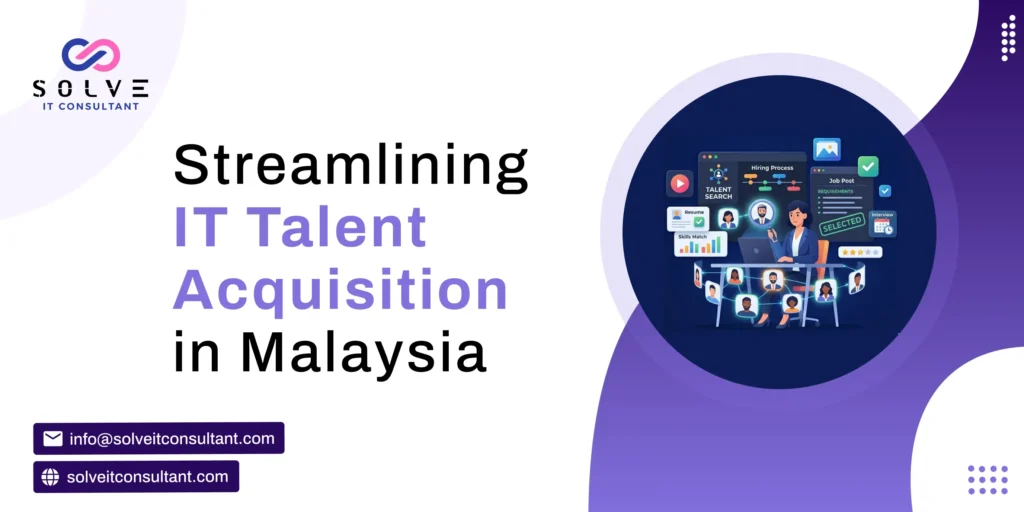
Malaysia is establishing itself as one of the fastest-growing digital economies in Southeast Asia. The country experiences substantial financial backing for technological fields, which include artificial intelligence, cybersecurity, cloud computing, and software development. International businesses are establishing their offices and technology centers in Malaysia because the country has developed its infrastructure systems and trained employees. The current digital expansion creates a significant requirement for IT experts who can work in various business sectors.
The process of trying to hire technology specialists with the necessary skills for their business needs creates significant challenges for companies. Organizations encounter difficulties when they attempt to locate candidates who possess both technical skills and practical work experience and industry expertise. The fight for highly skilled IT professionals has increased each year because of the growing demand for expertise in AI, data science, and cybersecurity. Organizations need to create better recruiting processes that allow them to successfully hire IT experts based in Malaysia.
Understanding Malaysia’s Growing IT Talent Demand
Digital transformation in Malaysia experiences rapid development across multiple sectors, including healthcare and finance, retail and logistics, and manufacturing. Companies implement new technologies to enhance their operational efficiency, customer service capabilities, and business processes. The industry now requires software developers, cloud engineers, cybersecurity experts, AI specialists, and IT project managers.
The expansion of data centers, fintech companies, and technology startups results in the creation of thousands of employment opportunities. The existing workforce cannot satisfy the increasing demand from the expanding industry. The growing demand for workers creates difficulties for companies because they need to compete against each other for the available candidates.
Major Challenges in IT Talent Acquisition
-
Shortage of Specialized Skills
Malaysia faces its most significant IT recruitment challenge due to its existing deficiency of specific technical expertise. Companies are searching for professionals with expertise in cloud computing, cybersecurity, AI, machine learning, blockchain, and software engineering. The demand for professionals has increased, but there are insufficient experienced candidates available to handle the requirement. Organizations face recruitment delays because of this shortage, which also results in increased expenses for their hiring activities.
Many organizations encounter difficulties when trying to locate candidates who possess both technical expertise and effective communication or leadership capabilities. Companies encounter difficulties when trying to hire mid-level and senior IT professionals because those positions require candidates who possess extensive practical experience in the industry. The common practice among organizations to compete for identical candidates results in both rising pay rates and increased employee departures.
-
Brain Drain and Talent Migration
Malaysia has faced talent migration problems for many years, but these problems have particular effects in the technology sector. IT professionals with expertise and skills choose to work in Singapore, Australia, and the UAE because those countries provide better income and international work experience and better opportunities to advance their careers. The migration of workers from Malaysia to other countries takes away skilled professionals who would work in the Malaysian job market. The result creates problems for businesses because they lack access to enough qualified IT personnel who can help build stable IT teams.
The rising competition from foreign employers is compelling Malaysian firms to develop new methods for keeping their staff members. Modern employees select their workplace based on their preference for work-life harmony and their desire to develop professionally. Businesses that do not fulfill these requirements will experience ongoing talent loss as skilled employees seek work in international markets.
-
Rapid Technological Changes
Organizations require new technology systems and digital tools because they must manage their technological progress, which occurs at an accelerated rate. Professionals must develop their technical skills to match the demands of modern industrial standards. Organizations observe that their job candidates understand theoretical concepts, yet they do not possess practical experience with contemporary technological systems. Business requirements create a skills gap between actual employee abilities and workforce capacities.
The current technological environment requires organizations to establish continuous learning programs because artificial intelligence, automation, and cloud technologies are expanding at an accelerated pace. The current market requires employers to find employees who possess the ability to learn new technological systems and business requirements. Organizations that fail to train and upskill their employees will experience difficulties in maintaining their competitive advantage throughout the upcoming years. IT organizations now require continuous workforce development programs to improve their talent acquisition methods.
Strategies to Streamline IT Talent Acquisition
Build a Strong Employer Brand
A company requires a powerful employer brand to successfully attract IT professionals with technical expertise. Employees today seek more than financial compensation because they prefer organizations that provide options for professional development, flexible working hours, educational resources, and a supportive work environment. Organizations that support innovative work environments, together with employee health initiatives, will succeed in attracting exceptional employees. Businesses use employer branding to differentiate themselves from their competitors when they search for new employees in the labor market.
Organizations can enhance their employer branding through social media platforms, together with employee testimonials and professional networking sites. Job seekers develop trust in organizations when they present their success stories together with team accomplishments and their organization’s work environment. Candidates prefer to work for organizations that demonstrate their commitment to employee development and practice open communication. Organizations establish strong reputations,, which lead to successful recruitment efforts while assisting them in retaining their workforce through multiple methods.
Use AI and Recruitment Technology
Companies use current recruitment technologies to improve their hiring processes because these technologies help them work better and hire candidates faster. AI-powered recruitment tools enable automatic processing of resumes, which identify job-matching candidates and handle interview scheduling while improving candidate communication. The technologies enable recruiters to complete their work with less manual effort while businesses benefit from faster recruitment timelines. The automated system improves candidate satisfaction because it provides them with immediate feedback and real-time updates about their application progress.
Data-driven recruitment systems enable organizations to evaluate candidates according to three criteria: their skills, their professional experience, and their capacity to fulfill specific job requirements. Recruitment analytics deliver critical information about hiring success rates, the time spent on recruitment processes, and the performance of employees. Advanced hiring technologies enable companies to enhance their recruitment processes through improved decision-making and decreased time required to complete hiring. All organizations need to adopt AI-powered recruitment systems as their main method for acquiring information technology specialists.
Focus on Skills-Based Hiring
Many organizations are abandoning conventional recruitment practices, which rely on academic degrees and professional experience to assess candidates. The hiring method based on skills assessment evaluates candidates through their capacity to perform actual tasks, their technical knowledge, and their ability to tackle real-world challenges. This method enables organizations to identify skilled workers who lack conventional academic qualifications. The method helps organizations establish teams that possess both diverse backgrounds and superior skills.
Organizations evaluate the abilities of their candidates through coding assessments and technical interviews, project-based evaluations, and certification checks. The methods deliver better results because they enable evaluators to see the actual competencies of candidates. Skills-based hiring enables companies to hire candidates without formal educational credentials who possess the required job skills. The approach has become essential for companies operating in industries such as software development and technology because of their rapid evolution.
Strengthen Employee Upskilling Programs
Organizations in Malaysia need to adopt new recruitment strategies because IT professionals are now in high demand. Organizations need to develop their current employees through training programs because they need to handle future technology changes. The upskilling programs help employees develop their technical abilities while they acquire proficiency in contemporary digital tools and systems. The organization creates a workforce that has advanced technical abilities and essential future work competencies.
Organizations can provide their staff with certification courses and internal training sessions, online training modules, mentorship programs, and technical bootcamps. The process of continuous learning enables employees to establish higher confidence levels, which leads to better productivity performance and increased job satisfaction. Employees tend to remain with organizations that provide them with opportunities to develop their careers through professional growth initiatives. Businesses that implement effective upskilling programs decrease their need to hire new staff while they achieve better operational performance.
Partner with Specialized Recruitment Agencies
Multiple organizations across Malaysia are now establishing partnerships with dedicated IT recruitment agencies to enhance their recruitment procedures. The recruiting agencies maintain extensive professional contacts to obtain candidates who have already been assessed for their technical abilities. Recruitment agencies maintain knowledge about current hiring practices, together with information about salary rates and industry requirements. This process enables businesses to complete their selection of appropriate employees with greater speed and better productivity.
Specialized recruitment partners can help organizations decrease their hiring duration while enhancing candidate selection and handling extensive recruitment efforts. The personnel help organizations develop onboarding procedures together with workforce management solutions and methods for retaining their top employees. Recruitment agencies deliver essential assistance to organizations that need immediate employee acquisition, along with their proficiency in the industry.
Enhance The Experience For Job Candidates
The modern recruitment process for organizations needs to develop its candidate experience into a core operational element. IT companies need to establish an efficient and professional hiring procedure because their qualified IT candidates receive numerous concurrent job offers. The employer’s reputation suffers through three specific factors, which include slow communication, extended interview processes, and ambiguous hiring methods. Candidates who experience an unsatisfactory recruitment process will choose to work for competing companies.
Organizations should focus on faster interview scheduling, clear communication, timely feedback, and transparent recruitment processes. Check out our latest blog post on Advantages of Custom Software for Malaysian SMEs.
The Future of IT Recruitment in Malaysia
The printing industry in Malaysia will operate in the future through three major factors, which include technological innovation, business adaptability, and employee skill development. Organizations will keep spending money on artificial intelligence and automation, cybersecurity, and cloud technologies, which will create a higher demand for IT professionals with expertise. Companies that implement contemporary recruitment techniques together with workforce development initiatives will obtain a distinct market advantage. The recruitment methods of the future will establish themselves as technology-based systems that use data analytics to drive their operations.
IT recruitment will transform three major work models, which include remote work and hybrid offices, and flexible staffing procedures. Employees now prefer organizations that offer flexibility, career growth, and supportive work environments. Businesses need to establish persistent methods for developing talent that should extend beyond their immediate needs for staff recruitment.
Conclusion
The need to simplify IT talent recruitment processes in Malaysia has grown because the country is developing its digital economy, which requires increasing IT talent recruitment efforts. Businesses face multiple obstacles because they have to deal with staff shortages, talent migration, and the fast pace of technological advancements, which increases competition for new workers. Contact us as the solution requires organizations to implement better recruitment methods, and they need to spend money on developing their staff, and they must enhance their hiring procedures. The organization needs to establish a future-ready skilled workforce to achieve its long-term business objectives.
Organizations that implement AI-based recruiting methods, develop their employees through skills training, and prioritize candidate experiences will establish a workforce that meets their upcoming staffing requirements.