Technology has become one of the core parts of how businesses in the United States run, talk with customers, deliver services, and keep competing. Still, as companies start to use artificial intelligence, cloud platforms, automation, and digital applications, their IT environments get more layered, more complex, and kind of all at once.
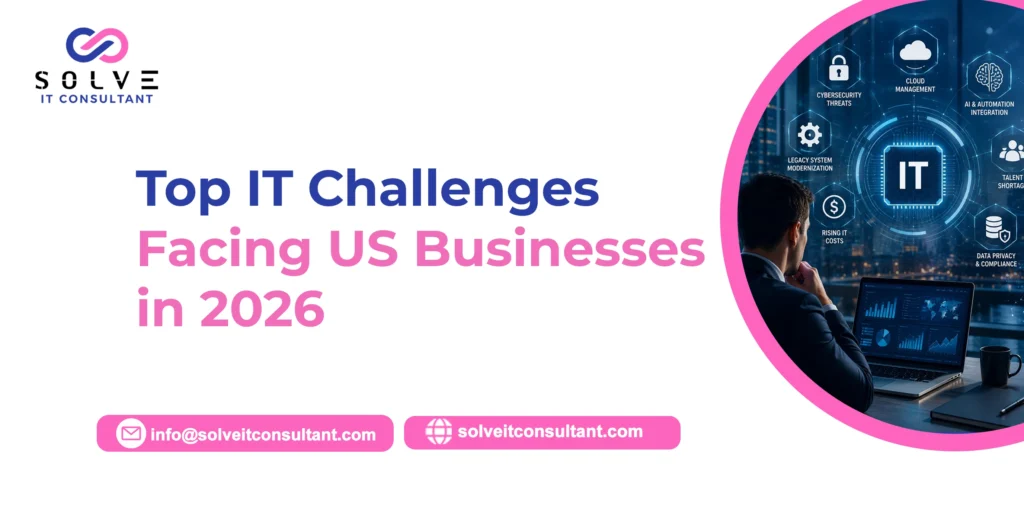
In 2026, businesses are facing that messy mix of cybersecurity threats, technology costs that just keep climbing, older legacy systems that won’t go away, AI governance headaches, cloud complexity, and shortages of specialized IT talent. Recent research from KPMG says 56% of US organizations feel that the cost of dealing with technical debt is a real obstacle when they want to invest in new technology, and 40% are still dealing with weekly IT glitches.
So for businesses, the difficulty isn’t only “should we adopt this new tech” anymore. The bigger task is to make technology secure, steady, cost-aware, and actually aligned with business objectives, not just some IT checkbox.
-
Increasing cybersecurity threats
Cybersecurity is still sitting at the top of the list of IT troubles for US businesses in 2026. Firms of every size are facing phishing, ransomware, identity-based attacks, data theft, plus other clever threats.
The danger goes up because businesses are linking more cloud applications, remote devices, AI tools, and third-party services into their networks. KPMG’s 2026 cybersecurity research reports that 83% of organizations saw an increase in cyberattacks compared to the prior 12 months.
Because of that, businesses need more than the classic antivirus programs or “set it and forget it” firewalls. They need continuous monitoring, multi-factor authentication, ongoing employee security training, strong endpoint protection, regular backups, vulnerability management, and a properly tested incident response plan.
-
Managing AI Adoption and AI Governance
Artificial intelligence is opening up real chances for US businesses, but adopting AI in a responsible way is turning into one of those big IT problems, you know.
A lot of companies are already using AI across customer service, software development, data analysis, marketing, automation, and internal day-to-day operations. Still, the tricky part is that organizations also have to keep an eye on data privacy, security, accuracy, intellectual property, access controls, and the overall hazards tied to AI-generated outputs.
Then there is the whole cost discussion too. An EY US survey, published in July 2026, said 82% of senior leaders at organizations investing in AI were worried about AI token usage and related expenses. The same survey also pointed to bigger and bigger issues around governance, talent, cost, and trust, without much delay.
To move forward, businesses need AI rules that spell out which tools employees may actually use, what types of information can be entered into AI systems, how any AI-generated content should be checked, and who ends up owning the AI-related risks in practice.
-
Legacy Systems and Technical Debt
Lots of US businesses are still running on older applications, servers, databases, and infrastructure. KPMG reported that 40% of US firms surveyed were still running into weekly IT glitches, and technical debt stays a major obstacle when it comes to new technology investments.
The answer is not always to swap everything all at once. Companies can modernize in steps by spotting the most critical systems, shrinking the pile of technical debt, updating software that’s no longer supported, improving integrations, and laying out a long-term IT modernization roadmap.
-
Rising IT and Technology Costs
Technology investment is growing, but businesses still need to make sure their spending actually turns into something measurable, not just activity. Cloud subscriptions, cybersecurity platforms, AI services, software licenses, infrastructure, IT support, and specialized employees can pile up recurring costs pretty fast. And AI adoption adds yet another layer, especially when organizations rely on high-volume models, or when autonomous AI workflows run for long periods with little oversight.
Because of that, companies are starting to focus more on IT cost optimization than on expanding their technology budgets. EY’s 2026 research indicates that US executives are steadily more interested in balancing AI spending with clear business value.
-
Cloud Management and Infrastructure Complexity
Cloud computing offers scalability and flexibility, but as the cloud footprint grows, managing everything can get messy.
Many businesses end up running several cloud providers, SaaS apps, private infrastructure, and also on-premises systems all at once. That hybrid setup can introduce problems tied to security, data movement, performance, compliance, monitoring, and of course, costs.
AI also makes infrastructure planning more critical, since AI workloads often demand serious computing and storage resources. Recent enterprise research has even highlighted that infrastructure plus data-governance gaps are among the key reasons organizations have a hard time scaling AI initiatives.
-
IT talent and skills shortages
Technology is moving, like, faster than many orgs can build their own internal IT capabilities or even keep up with it. And because of that, businesses end up needing professionals who truly grok areas like cybersecurity, cloud computing, AI, data stewardship, automation, and IT infrastructure. It’s tough to locate people who can stitch together technical know-how with business understanding, because it’s a bit more than just having one piece of the puzzle.
CIO research in 2026 found that hybrid IT roles that demand multiple skill sets are still among the hardest positions to fill.
Rather than leaning entirely on outside hiring, companies can put money into employee training and upskilling, so the talent grows from inside. Also, managed IT services can bring in specialized expertise when keeping a big internal IT department is not really feasible.
How US Businesses Can Prepare for These IT Challenges
The best approach is to build a proactive IT strategy instead of responding to technology problems only after they occur.
- Conduct regular IT and cybersecurity assessments.
- Identify and prioritize outdated systems and technical debt.
- Create clear AI usage and governance policies.
- Monitor cloud and software spending.
- Implement multi-factor authentication and strong access controls.
- Maintain reliable backups and disaster recovery procedures.
- Train employees regularly on cybersecurity.
- Invest in IT skills and employee upskilling.
- Monitor networks, endpoints, and critical systems continuously.
- Review third-party vendors and technology providers.
- Create a long-term technology modernization roadmap.
Why Proactive IT Management matters in 2026
The biggest IT challenge for US businesses isn’t really one specific tool or platform. It’s more like trying to steer multiple fast-moving technologies, along with the risks tied to them, at the same time, sort of continuously.
AI keeps opening up fresh chances, but it also brings fresh governance headaches and cost worries. Cloud platforms can give agility, but they also add a layer of infrastructure complexity that you can feel in daily operations. Cyber threats keep shifting, and at the same time legacy systems just won’t “get out of the way.” Plus, there are talent shortages that slow modernization down, even when teams want to move quickly.
So, a proactive IT strategy helps organizations strike that hard balance between innovation and things like security, reliability, and cost control. When companies regularly review what’s happening across their technology landscape and fix weak spots before they turn into big interruptions, they end up positioned better to expand inside a competitive digital economy.
Conclusion
In 2026, US businesses are basically living inside an IT setup that is more connected, more intelligent, and frankly more complicated than ever. Contact us. Among the biggest hurdles are cybersecurity threats, AI governance requirements, legacy infrastructure constraints, rising costs, cloud complexity, talent shortages, data privacy expectations, and downtime that nobody schedules on purpose.
The answer isn’t only to buy more technology. It’s about getting the right technology, using solid security practices, maintaining dependable infrastructure, having skilled people, and doing proactive IT management instead of reacting after the fact.
With a strategic plan for IT modernization, plus continuous monitoring of the environment, US businesses can lower risk, manage expenses, raise productivity, and build a sturdier base for long-term growth.